The Assault on Minneapolis and the Political Valences of Suburbanization

Minneapolis, Minnesota is under siege.
For just over a month and a half, armed and masked agents of the United States Immigration and Customs Enforcement (ICE) have been running Operation Metro Surge in Minnesota's largest urban area, the Twin Cities urban region of Minneapolis-St. Paul, and have been operating across the state. What "operating" means for ICE under the Second Trump Administration is ostensibly targeting illegal immigrants for detainment and deportation, but in actuality kidnapping anyone who isn't white (and some who are) and either disappearing them into the immigration detention system or releasing them after hours or days of charge-less imprisonment.
Public attention to ICE's campaign of terror against the Twin Cities' visible minority population (connected to a fraud case committed by a group of Somali-Americans that has been blown out of all proportion by the right-wing echo chamber and become a pretext to target the entire Somali-American community in Minnesota) had simmered at a low level for a month as the latest in the increasingly unpopular agency's national tour of harrassment, following similar missions of terror in blue-state cities such as Los Angeles and Chicago (Trump occasional threatens to go into New York City but I doubt these stretched-thin thugs want any of that smoke). But it exploded on and after January 7th with the shooting murder of Twin Cities resident, mother, and legal observer Renee Good by ICE goon Jonathan Ross, an outrage that has yet to be addressed with charges for Ross or any accountability of any kind.
What has developed since then is the most aggressively violent state repression of Trump II thus far coupled with the most dogged, intelligent, and persistent resistance to that repression from the Twin Cities' residents, thus far unassisted by city and state authorities (although both are under Democratic leadership) who have proved unwilling to risk further pique to Trump and his fascist goons with any sort of actual pushback. A robust communal response to ICE has developed, with Minnesotans tailing ICE vehicles, whistling, warning, and otherwise disrupting the agents' attempt to snatch people, complaining to hotel chains hosting ICE personnel, even guarding schools against invasion and buying groceries for minority neighbours who might be targeted. Trumpistas have brayed and insulted and threatened but these are the bleatings of a wounded animal. Time will tell, but Minneapolis' pushback and the terrible press that has dogged ICE and Trump's lieutenants in charge of the op since Good's death could well be a turning point leading to the downfall of Trump's attempt at an authoritarian regime in America.
But why Minneapolis? Why any of America's cities? Even now, the toxic publicity of ICE has not made supporting their incursions entirely radioactive, and as low as Trump's support is, it remains there and sizable. How is the targeting of any part of their own country for violent repressions of this sort acceptable to any American? Was not the American Right told for decades that the federal government would soon come for them and their sacred constitutional rights, and thus they must oppose it however they can while stockpiling firearms and cosplaying as paramilitary militias to resist the attempt? Where are they now that it is demonstrably happening, other than cheering it on from their couches?
I have a theory that serves to address this, one that has percolated in my head for some time. A fuller elucidation of the theory may have to wait for a later post, but ICE's assault on Minneapolis and the circumstances that made it something that the Always Posting Online Administration (a clicktatorship, as a Wired article cannily dubbed it) thought would make for good content for the rubes make for a good case study to support it.
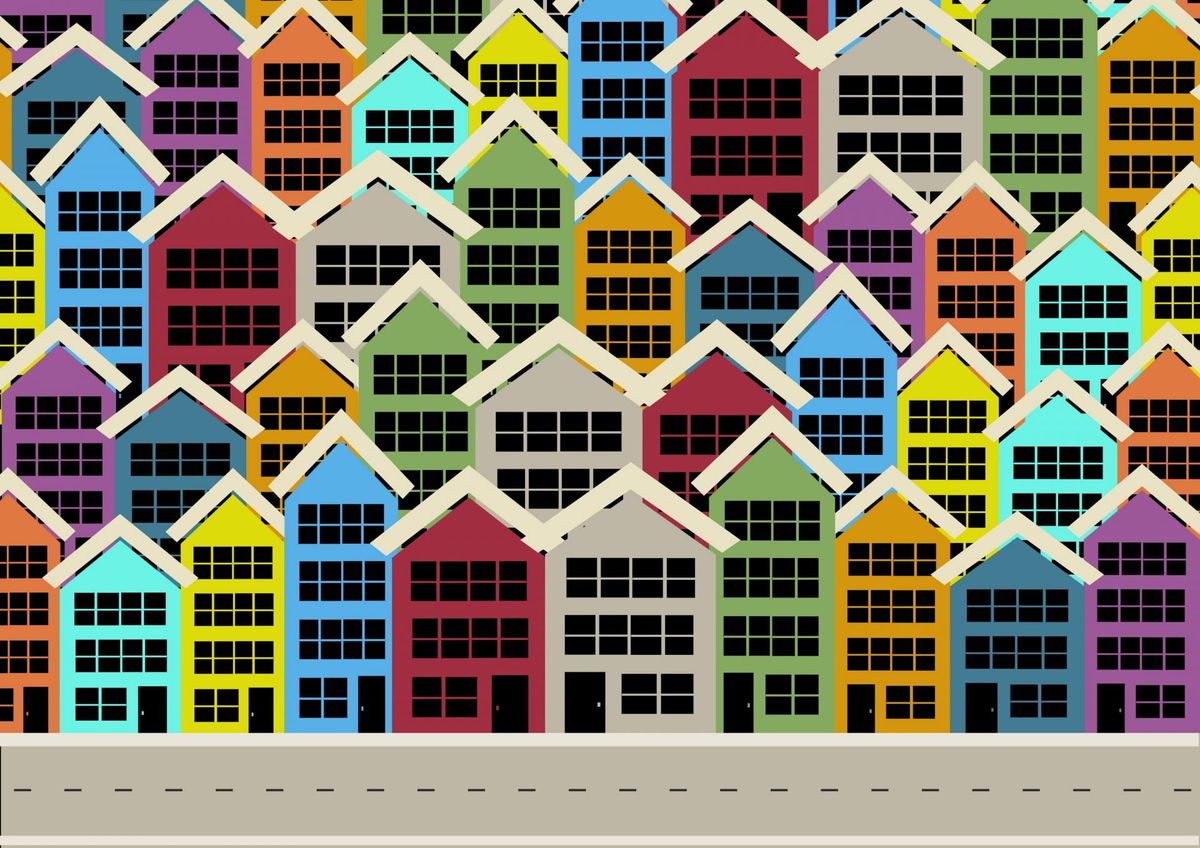
Essentially, we have arrived at our current social/cultural/political moment at least partly – and I would argue primarily – as a result of decades of suburbanization. Suburbs began to be built in the United States at the conclusion of World War II and following a decade of relative ascendance of socialist-ish policies under Franklin D. Roosevelt's New Deal, a social, economic, and political realignment formulated mainly in response to the stock market crash of 1929 and the deep poverty outcomes of the Great Depression. Over the next few decades, the suburbs became synonymous with the American experience, the housing and communal end goal of the vaunted American Dream. They were the focus of aspirational capitalism, the settings of Hollywood's seminal cultural touchstones of the 1980s (and still are down to today, with era homages like Stranger Things). The suburbs, for all intents and purposes, were America.
Of course, the suburbs were also engines of social and economic segregation, white flight enclaves from the messier multicultural melting pot of cities that swelled particularly during the elevated crime era of the late 1960s to the early 1990s, America's peculiar Years of Lead (Poisoning). The suburbs became "safe" and "clean" compared to the "dangerous and dirty" "inner cities", assumed labels whose racial valences lurked barely below the surface of discourse but were entirely in your face as social and economic realities. This element of the suburban narrative dovetails with another larger theory I've been knocking about with, the comprehensive delineation of the contours of Crime Hysteria and its many results and consequences, that I will likewise return to in greater detail one day.
All of these elements of the suburbs are pretty commonly recognized and understood, even by their erstwhile defenders. But the suburbs are also engines of economic exploitation and of political and social conditioning, and indeed those functions supersede any of their more recognized functions or sources, in my estimation. William Levitt, the real estate developer who laid out America's first suburb in Levittown, NY, notoriously said that "no man who owns his own house and lot can be a communist, he has too much to do." The post-war and post-New Deal rise of the suburb can be seen to be part of a distinct political project, namely the post-war rehabilitation, renewal, and rebranding of the right-wing politics that had led directly to Europe's killing fields and the Nazi death camps.
Cold War anti-communism sought to counter the unpredictable social and cultural and political synthesis of the dense cities, full of refugees from the Old World's oppressive autocracies and authoritarian states tesselating with each other and naturally gravitating to collective solutions to collective problems. Likewise, America's expanding corporate world sought to open new market horizons, new avenues to part the swelling American middle class from their New Deal-driven rising incomes.
The suburbs were their shared solution, a machine of social conditioning, political training, and consumption growth. Citizens would become consumers, would be atomized and isolated from each other to discourage collective politics, and the result would be conservative and corporate hegemony. The automobile was the key wedge, the suburban neighbourhoods separated from essential services and retail let alone the distant urban nightmare by such expanses of space that walking, transit, or other conveyances like biking that it made car ownership, and its numerous attendant revenue streams, a practical necessity.
Without going into more details into this theory, this is how dull, majority-white Minneapolis became one of many urban bugbears to the American Right. The Republican subject has grown isolated in the suburbs (and exurbs and rural areas, yes) from direct experience of the cities, which have themselves developed and gentrified over the decades since the Years of Lead (Poisoning) to the point that they little resemble the crime-torn inner cities that white flight to the suburbs flew from. Whether they recognize their ignorance or not, whether they resent the city and their denizens because they are told to, or because they apprehend the fulfilment gap between their suburban experience and the renewed urban one and thus envy the city and therefore hate it. Again, there is more to draw out from this framework and from the social psychology of suburban homeostasis, and that is for another time. Suffice it to say that the angry, hateful energy that drives ICE assaults on Democratic-state cities has roots in the prior decades of suburban conditioning of political and social priorities.